Colt .44 revolver
The Colt .44 revolver, specifically the 1860 Army Model, is a pivotal object in Philip K. Dick's novel, appearing in three distinct contexts that together illuminate the book's central concerns with authenticity, historicity, and the moral weight of material objects. It first surfaces as a supposed Civil War relic in Robert Childan's store, then as a treasured collector's item in the hands of Nobusuke Tagomi, and finally as a weapon of self-defense, each incarnation forcing a reconsideration of what gives an object its value and meaning.
The Forged Colt .44 and the Crisis of Authenticity
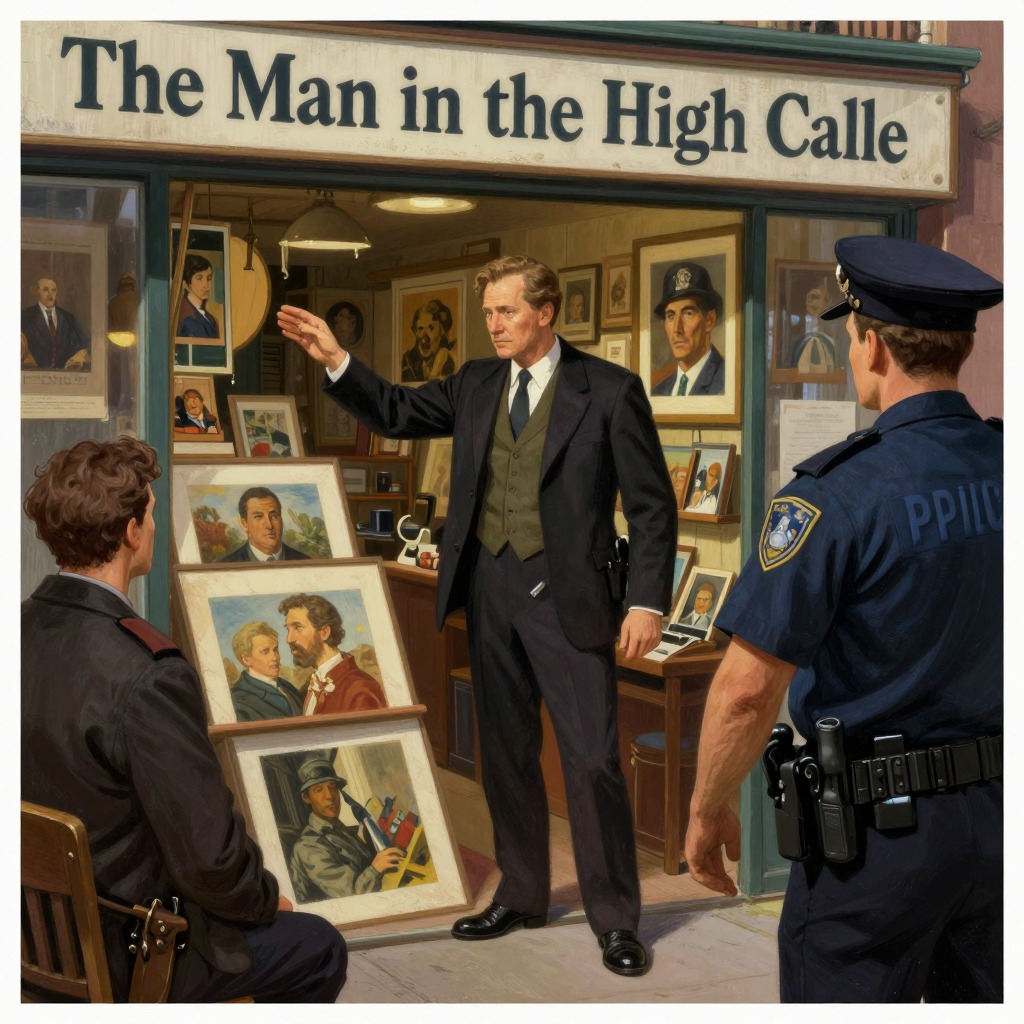
The revolver's first appearance is as a counterfeit. When a man claiming to be Admiral Harusha's gentleman visits Childan's shop, he examines a Colt .44 that Childan presents as an authentic Civil War sidearm. The visitor immediately identifies it as a fake, noting that the wood has been "artificially aged by an acid chemical." Childan, stunned, sends the gun to the University of California Penology Department for analysis. The lab report confirms the worst: it is "a reproduction cast from plastic molds except for the walnut," with "serial numbers all wrong" and surfaces artificially aged. The technician reveals that there is "a regular industry turning out these fakes," a fact that shatters Childan's confidence in his entire stock. This incident exposes the fragility of the Americana market, where Japanese collectors, lacking proper standards, are easily deceived. Childan's subsequent investigation traces the gun back to Ray Calvin Associates, a wholesale supplier, and he confronts Ray Calvin, demanding restitution. The episode forces Childan to confront the possibility that his livelihood is built on a lie, and it plants the seed for his later interest in contemporary, non-historic objects like the Edfrank jewelry.
The Collector's Item and the Weight of History
In stark contrast to the forged gun, a genuine Colt .44 appears as part of Mr. Tagomi's personal collection. When the SD men attempt to seize Rudolf Wegener in Tagomi's office, Tagomi retrieves the revolver from his desk drawer, describing it as "a perfectly preserved U.S. 1860 Civil War Colt .44, a treasured collector's item." He loads it with "loose powder, ball and cap ammunition" and, with "record-eclipsing speed," fans the hammer, killing one SD man and wounding another. This act of violence, performed with a historical artifact, transforms the gun from a passive object of contemplation into an instrument of deadly force. The revolver's historicity—its connection to the American past—becomes entangled with Tagomi's present moral crisis. After the shooting, Tagomi is haunted by the act, and he later attempts to trade the gun back to Childan, hoping to rid himself of its "subjective history." Childan, however, refuses, sensing the gun's tainted significance. Tagomi's inability to divest himself of the weapon symbolizes his inability to escape the moral consequences of his actions. The gun, once a symbol of American heritage, now carries the weight of Tagomi's guilt, its historicity fused with personal trauma.
The Gun as a Symbol of Historicity and Moral Choice
The Colt .44 also serves as a vehicle for the novel's philosophical meditation on historicity. Wyndam-Matson, in a conversation with his mistress Rita, uses two Zippo lighters to illustrate his cynical view: one allegedly belonged to Franklin D. Roosevelt, the other not, yet they are indistinguishable. He argues that "historicity" is a "mass delusion," a value imposed by documents rather than inherent in objects. The Colt .44, in its genuine and forged forms, embodies this tension. The forged gun has no historicity, yet it is sold as if it did; the genuine gun has historicity, but its meaning is transformed by Tagomi's use of it. Tagomi's later meditation on the Edfrank silver triangle, which he buys from Childan, echoes this theme. He reflects on the object's "body of yin, soul of yang," seeing in it a union of the dark, earthly metal and the brilliant, heavenly light. This contemplation, which leads to a moment of near-mystical insight, suggests that true value may lie not in historical provenance but in the object's intrinsic qualities and the response it evokes. The Colt .44, in its various manifestations, thus becomes a touchstone for the novel's exploration of what makes an object meaningful: its history, its use, or its inherent nature.
The Revolver's Role in the Narrative's Moral Economy
The Colt .44's trajectory through the novel traces a moral arc. As a forgery, it represents the corruption of the Americana trade and the exploitation of Japanese collectors' trust. As a collector's item, it represents the legitimate appreciation of history, but also the burden of that history. As a weapon, it becomes a tool of violence, forcing Tagomi to confront the reality of killing. The gun's final appearance, when Tagomi tries to trade it in, underscores his psychological state. He tells Childan, "I wish to trade in an item bought several years ago," but Childan, sensing the gun's dark history, refuses. Tagomi is left to carry the revolver, a constant reminder of his actions. The gun, which once symbolized American heritage, now symbolizes Tagomi's moral burden, and his inability to shed it reflects the novel's broader pessimism about the possibility of escaping the past. In this way, the Colt .44 is not merely a prop but a character in its own right, its history and meaning shifting with each owner and each use, ultimately embodying the novel's central question: what gives an object its value, and what does it mean to possess it?